




Panorama archive · Education
The Roots of Justice
Originally published
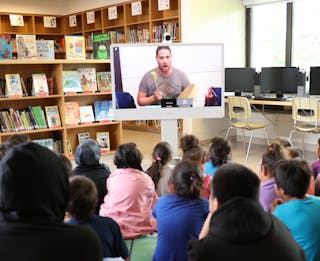
Elonnie Junius Josey urges librarians to remember the roots of justice through his oration of John Berry Meachum’s journey from slavery to freedom in 1789. Meachum eventually became a successful carpenter, and cabinetmaker in St. Louis and bought his freedom. At the time the laws of the State of Missouri prohibited black children from learning how to read. Meachum built a river boat and fitted it with classrooms, and anchored it in the middle of the Mississippi away from the state of Missouri’s jurisdiction (Griot Museum, 2011, para. 11). Each morning there were small boats that were leaving the docks carrying the young black children to school where they could not be touched by State law, because they would not be on the State land. Meachum furnished a library on board this riverboat so that the children could read during their spare time. Meachum also operated another boat which carried temperance literature and other literature to boats on the Mississippi which inspired many slaves to pursue their freedom.
Meachum’s journey to freedom resonates with my journey to freedom on many different levels of identity. The river boat Proud Mary could reflect Meachum’s wife who was named Mary. Mary Meachum taught Black children how to read on the river boat so I think of her as a river boat Queen who instilled pride in black children through literacy. The lyrics in Proud Mary could be interpreted as a slave singing about achieving freedom from riding the river boat and learning to read. When I learned to read and returned to school I had the freedom to make informed decisions and explore many career paths to facilitate my journey to the Promised Land.
As John Fogerty wrote “But I never saw the good side of a city until I took a ride on a river boat queen” (1967, para. 5) , the good side of a city could mean a city of liberty and freedom. The ride on the river boat queen could symbolize slaves learning to read and freeing themselves through the power of literacy. Rolling on the river symbolizes “justice flows down like water and righteousness like a mighty stream” (King, 1963, p.12). I realize that John Fogerty was writing about a woman washing clothes on a wash board on a river boat (1967, para.7), however, the images of the cleansing and transformative properties of water reflects a baptism and sea change for freedom. A baptism frees the soul of sin and hate. The water cleansed the contempt the slaves had towards their slave-owners just as it cleansed the hate I had towards my step father.
Fogerty’s lyrics “If you come down to the river, bet you gonna find some people who live, you don’t have to worry if you have no money, people on the river are happy to give” (1967, para.9), reflects (even without his intent) Harriet Tubman’s Underground Railroad song Wade in the Water which guided runaway slaves to the land of freedom towards the northern star of freedom in Canada. Tubman’s helpers on the Underground Railroad never charged fugitive slaves money for lodging, provisions or transportation on their journey of freedom.
On another level of identity Meachum’s river boat library reminded me of Tina Turner singing the song Proud Mary. Turner’s ability to survive the abuse from her husband Ike and persevere in her career inspired me to survive the abuse from my husband and to persevere in school. Her ability to overcome racial discrimination from white American society, gave me the strength to overcome gender discrimination from my Iranian father and racial discrimination from my stepfather who called me a no good half-breed. The water cleansed the contempt the slaves had towards their slave-owners just as it can cleanse the hate between the oppressors and the oppressed people today. Libraries can be seen as rivers of knowledge washing away the hate and ignorance that oppresses society.
References
Fogerty, J. (1967). Proud Mary. Creedence Clearwater Revival Meanings & Lyrics. Retrieved From: http://www.CreedenceClearwaterRevivalCCRMeanings & Lyrics.
Jimmyogle. (1998). Proud Mary Waterways Journal. Retrieved From: http://jimmyogle.com/ProudMaryWaterwaysJournal1998.jpg
Josey, E.J. (2009). Speech by E.J. Josey. California Librarians Black Caucus. Retrieved From: http://clbc.org/2009/07/speech-by-e-j-josey/
King, M.L. (1963). Martin Luther King Junior. Oxford Press. New York.
The Griot Museum of Black History. (2011). 2505 St. Louis Ave. St. Louis, MO 63106-2324 Phone: 314-241-7057. Fax: 314-241-7058 Retrieved From: http://www. TheGriotMuseumofBlackHistoryandCulture.com.
Violanti, A. (1993). Tina Turner, Up From Brutality. The Buffalo News (Buffalo, NY). Dialog LLC. 1993. Retrieved November 04, 2012 from HighBeam Research: http://www.highbeam.com/doc/1P2-22517077.html.