



Panorama archive · Education
Sprout E-course Alumnus Story: Kazi Mamun Ur Rashid
Originally published
In Bangladesh, many entry-level technology workers are unable to earn sufficient income to support all family members in their household. A computer operator inputting data earns $80-$100 per month, but the cost of supporting his or her family is $200 to $250 per month. Earning less than a subsistence wage leads to debt problems as well as perpetuating the cycle of poverty, because families cannot afford to send their children to school. Children often begin to work at a young age in low-paying and unskilled jobs, missing out on crucial education opportunities as well.
While workers want to gain new tech skills, they do not have money for education, because every dollar they earn is going to feed their family.
The Family project seeks to solve this problem. In its current pilot stage, ten workers in Bangladesh have been chosen to receive technical training from 15 volunteers in the tech industry. Volunteers are recent university graduates working successfully in the field, and skills include Microsoft Office as well graphic design and programming.
Project lead Kazi Mamun Ur Rashid explains: “If we can empower the key [earner] of any family, that helps a family to fulfill their basic needs like food, shelter, medication, education. So we are actually empowering the whole family through empowering one person.”
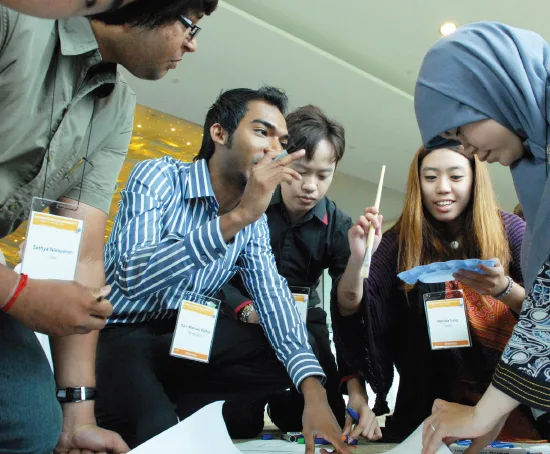
Kazi recently graduated in Computer Science and Software Engineering and now works at a software firm. He was a Microsoft Student Partner in Bangladesh for two years as campus lead and event and marketing lead. He attended a Microsoft YouthSpark event in Singapore, where he met a number of mentors and his team was inspired to develop the Family project: “The speeches from different people that are social innovators already were really inspiring to us,” he says.
Microsoft YouthSpark has “inspired me to keep moving with my project. I was stuck with what to do next,” says Kazi. “Especially the TakingITGlobal Sprout course: that course helped me a lot to organize the metrics of my project, of my organization.”
Within 25 days of launching the Family project on Microsoft YouthSpark on Global Giving, the team reached its goal. The project’s network became international and the team continues to engage in Microsoft webinars and social innovation seminars to help build their strengths and grow their project.
The team is currently campaigning on various university campuses to get more volunteers for the project, and hope to expand to 100 families and become a sustainable long-term organization, following its current pilot phase.