



Panorama archive · Education
Sprout E-course Alumnus Story: Ivonne Chavez
Originally published
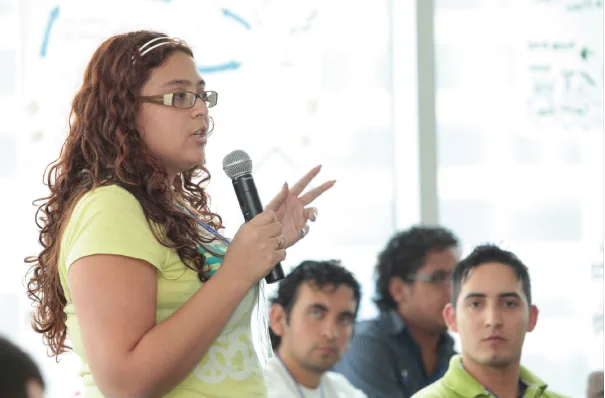
A 24-year old Costa Rican has developed a smartphone app that allows visitors and residents of rainforest areas to report natural events or illegal activities that threaten the environment. Users can also track species sighted and changes in the habitat, as well as accessing a database to learn more about the areas.
Costa Rica faces numerous threats from illegal logging, poaching, burning and other activities in areas that are often distant from villages and ranger stations. As the government has cut the number of park guards and rangers across the country, responsibility for reporting poaching and illegal logging has fallen increasingly upon the citizens and visitors of Costa Rica. It is a day-to-day struggle to save indigenous species from poachers; for example, the jaguar population in the Corcovado National Park has dropped from 100-150 in 2000 to just 30-40 this year. In some areas, some native species have disappeared and must be reintroduced.
The app, which will launch in 2014, is called E-cological and was developed by a team led by Ivonne Chavez, a computer engineer and Microsoft Student Partner from San Jose, Costa Rica. The app is dynamic and the technology could be applied in high-risk regions throughout the world. It uses Microsoft Visual Studio, Bing Maps, and MS Translator among other software, with connectivity to social networks like Facebook and Twitter.
Complaints from the general public can be made via email, with the ability to attach photos or other evidence of the reports. The app then sorts the report type and redirects the complaint to the appropriate agency. Chavez’s team is working closely with Ranger Groups from Costa Rican Conservation Areas and governmental authorities as they enter the final stages of development.
In addition to reporting illegal activity, the app is also useful for reporting and monitoring natural disasters, such as fires, which can spread quickly if not detected by remote ranger stations. Chavez notes: “We cannot prevent natural disasters, but we can help to localize them using this technology.”
The idea for E-cological was presented by Chavez at a Microsoft YouthSpark event, which she attended in Mexico City last year. Through it, Chavez had the opportunity to develop and share her idea with young people from across Latin America, as well as mentors from TakingITGlobal and Microsoft.
“Each of us had opinions, experiences, ideas and ways of being different,” says Chavez. “I think that was the spark for each of us. That entrepreneurship and desire to change the world. We learned business, marketing,elevator pitches and how to use our technical knowledge to innovate for good.”
Chavez then enrolled in a Sprout e-course byTakingITGlobal. Through that course, “I learned more deeply about how to market the project, how to organize, how to stay motivated in the project. I also learned how to get sponsors, and steps for how to get help.”
Through the social networks that developed out of Microsoft YouthSpark and Sprout, Chavez and her team have connected with like-minded young developers to exchange ideas and refer one another to useful resources and contacts. Because everyone is working towards the same goal (protecting the environment), they are not hindered by any of the proprietary competitiveness that can prevent the free flow of ideas in other types of entrepreneurship.
As the project reaches completion, Chavez continues to be in touch with other Sprout e-course participants, whom she describes as family. “I love that we can share everything about our projects.”