






Raphael Shonde
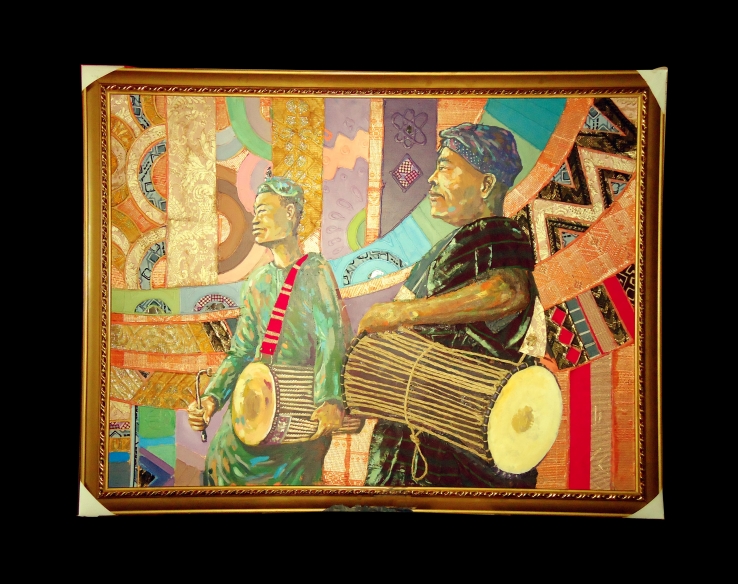
View artist portfoliothe yoruba way of life with the use of gan-gan (talking drum)as a means of sending message before it is now used as musical instrument.
- Country
- Nigeria
- Submitted
- 2012-04-10
- License
- Attribution – No Derivatives


Mixed Media
the yoruba way of life with the use of gan-gan (talking drum)as a means of sending message before it is now used as musical instrument.
An archive of young people’s creativity. Historical comments are preserved; new submissions and comments are closed.
Historical comments (9)
Archived conversations. New comments are closed.
This is a great painting!! I really like it!
this is a really good manifestation of your culture!
i really take my time in doing this mixed media.
the size is 6feet X 4feet
Wow, that big man looks like someone from my community (Tamale, Ghana), who is also a drummer. Looks real, Good job.
It is also used for making announcements and for festivities in my culture - Dagbon culture. This is why I've fallen for this painting.
Can you explain the meaning of this art? :)
maybe Shonder can best explain it to you since its his painting.
thanks @chenty
‘’We are not Africans because we are born in Africa, we are Africans because Africa is born in us’’
This statement lays more emphasis on the culture and behaviour of the Yoruba people in reference to their talking drum (gan-gan, iya ilu), attires (aso-oke), how to appreciate our language and our culture.
The mixed media painting bring us back to the use of Talking Drum which is closely tied to the Yoruba language of South Western Nigeria. In Yoruba land, the talking drum is a percussion to which people can rhythmically dance, but the significance of the Yoruba talking drum goes beyond mere entertainment value. More so, our richly culture that is been gnaw away by the western way of life.
ORIGIN OF THE TALKING DRUM
The talking drum of the Yoruba originated from Oyo. It was first assembled for the King (Alaafin) , as his musical outfit whenever he goes to war. He used it to motivate his army. Today, we celebrate it because it is one of the things the Africans, the Oyo people and Yoruba gave to the world and which cannot be done by any other.
The drums are used at birth, in ancestor worship, rites of passage, healing, storytelling, warrior rites and initiation, at the time of death, and as an important means of communication over long distances
The drum is the greatest purveyor of rhythm and rhythm is arguably the most definitive of musical style in popular contemporary music. Although, we use the drums in our music, mostly to create grooves and stimulate dance, in traditional Yoruba music the drum plays more diverse roles. They do much more than stimulate dance, especially in the sacred worship of Yoruba deities.
One of the unique features of the instruments is their ability to closely imitate the rhythms and intonations of spoken language. In the hands of skilled performers, they can reproduce the sounds of proverbs or praise songs through a specialized "drum language" - their dialogue can be easily understood by a knowledgeable Yoruba audience. Whether accompanying dances, or sending messages, the sound of these instruments can carry many miles.
Specific talking drum patterns and rhythms are also closely linked with ogun, or spiritual beings associated with the traditional Yoruba belief system originally celebrated in Nigeria.
This century, talking drums have become an important part of popular music in West Africa, especially in "juju", a genre which finds its roots in traditional Yoruba music, indigenous guitar bands and the British brass band heritage in Nigeria.